
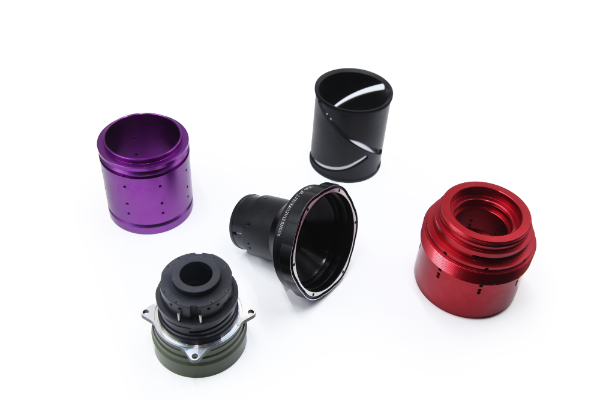

The material chosen for your lens barrel, camera housing or optical mount directly determines thermal stability, weight, corrosion resistance, machining accuracy and long-term durability.
Many engineering teams select materials based only on cost or availability, only to discover thermal drift, warping, corrosion or assembly interference in real-world testing. For optical devices, material choice is a performance decision, not just a procurement decision.
Below is a clear, application-focused comparison of the three most used metals in precision optical components, with direct guidance on which to use for your project.
1. 7075-T6 Aluminum: The Standard for Most Optical Systems
7075-T6 aluminum is the dominant material for optical lens barrels, industrial camera housings and ADAS structural parts, and for good reason:
• Excellent strength-to-weight ratio, ideal for compact optical designs
• Superior machinability for complex, tight-tolerance features
• Stable dimensional performance under moderate temperature changes
• Fully compatible with hard anodizing, color anodizing and passivation
• Cost-effective for rapid prototyping and small-batch production
Best applications: Machine vision lenses, ADAS camera housings, security optical components, industrial detection modules, general precision optical structures.
2. Ti-6Al-4V Titanium: For Extreme Environment Optical Systems
Titanium is the premium choice when thermal stability, vibration resistance and durability are non-negotiable.
• Extremely low thermal expansion rate, critical for high-precision optical path alignment
• Outstanding corrosion resistance, even in saltwater, high-humidity and outdoor harsh environments
• Highest strength-to-weight ratio of common structural metals
• Stable performance under extreme vibration and temperature cycling
Best applications: Marine optical surveillance, aerospace optical components, high-temperature industrial detection systems, long-life outdoor optical equipment.
3. 304/316 Stainless Steel: For Rugged, High-Impact Enclosures
Stainless steel is rarely used for core optical lens barrels, but is ideal for structural housings, mounting brackets and rugged external components.
• Unmatched impact and wear resistance
• Permanent corrosion resistance without additional coating
• Stable performance in industrial, outdoor and washdown environments
Best applications: Outdoor security camera enclosures, heavy-duty optical mounting brackets, industrial-grade optical equipment frames.
Critical Note: Surface Treatment Directly Affects Dimensional Accuracy
One of the most overlooked failure points in optical parts is dimensional change caused by anodizing and surface coating. Improper surface treatment will shift critical tolerances, cause lens assembly interference, and destroy optical alignment.
All tight-tolerance optical parts require pre-calculated dimensional compensation before surface treatment, with strict process control to avoid over-etching and deformation.
If you are unsure which material or surface treatment fits your application, share your operating environment, tolerance requirements and performance goals for a targeted material recommendation.
